These are twenty words that may be useful to someone who is going in electric engineering
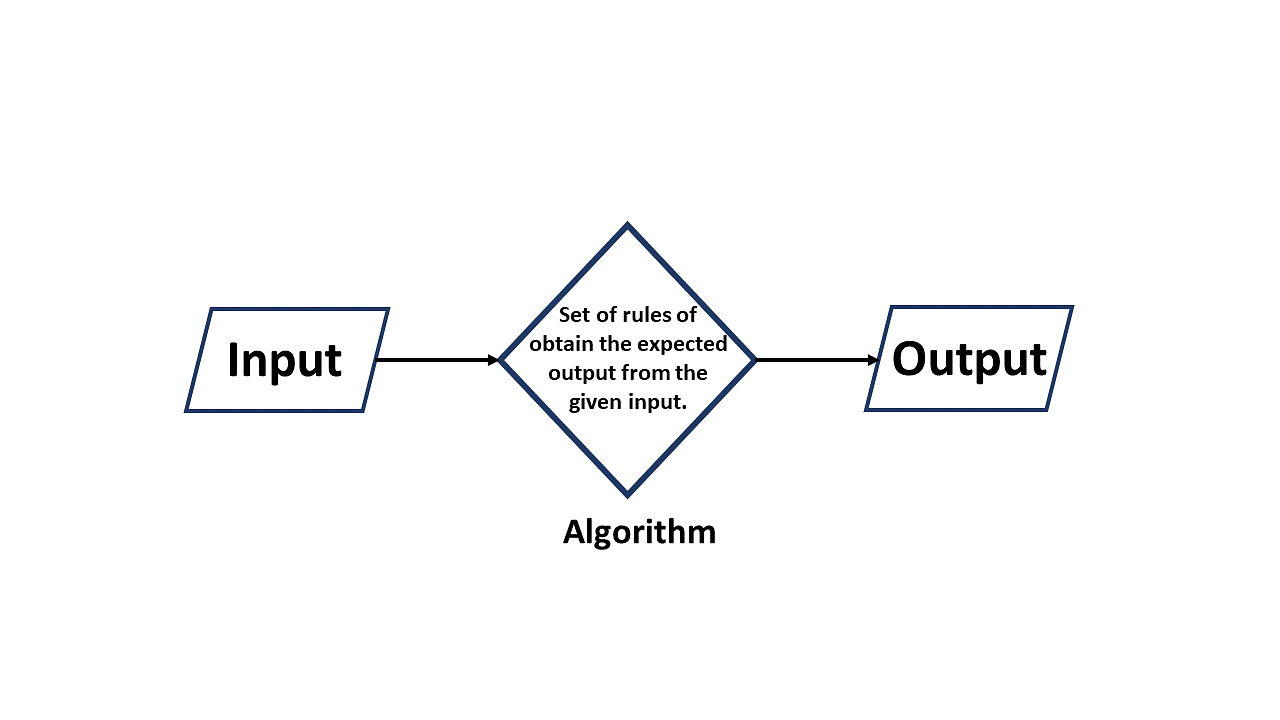
algorithm
noun
A process or set of rules to be followed in calculations or other problem-solving operations, especially by a computer.
Example: The main ALGORITHM then operates on each 512-bit message block in turn, each block modifying the state.
en: algorithme
alternator
noun
A generator that produces an alternating current.
Example: His present set-up uses a turgo turbine which drives a 230v AC output ALTERNATOR.
en: alternateur
calculus
noun
The branch of mathematics that deals with the finding and properties of derivatives and integrals of functions, by methods originally based on the summation of infinitesimal differences. The two main types are differential calculus and integral calculus.
Example: Objects respond to gravity by following the curved paths of space-time (geodesics, described by metrics and tensor CALCULUS) around massive objects.
en: calcul différentiel et intégral
capacitor
noun
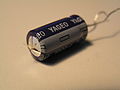
A device used to store an electric charge, consisting of one or more pairs of conductors separated by an insulator.
Example: The photocell was connected to the CAPACITOR, and a multimeter put across it to measure the voltage.
en: condensateur
frequency modulation
noun
The modulation of a radio or other wave by variation of its frequency, especially to carry an audio signal.
Example: Frequency modulation is widely used for FM radio broadcasting.
en: modulation de fréquence
fuse
noun
Provide (a circuit or electrical appliance) with a fuse.
Example: There is no need to FUSE the circuit any higher unless there is other equipment on the same circuit.
en: fusible
gamma rays
noun
Penetrating electromagnetic radiation of a kind arising from the radioactive decay of atomic nuclei.
Example: These effects will split energy levels within the nuclei and hence will split the lines that appear on the spectrum where the GAMMA RAYS have been absorbed.
en: rayons gamma
haptic
adjective
Relating to the sense of touch, in particular relating to the perception and manipulation of objects using the senses of touch and proprioception.
Example: Haptic feedback devices create the illusion of substance and force within the virtual world.
en: haptique
horsepower
noun
The power of an engine measured in terms of horsepower.
Example: A strong 140-horsepower engine.
en: puissance
inductor
noun
A component in an electric or electronic circuit which possesses inductance.
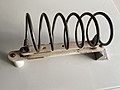
Example: An INDUCTOR typically consists of an electric conductor, such as a wire, that is wound into a coil.
en: inducteur
inertia
noun
A property of matter by which it continues in its existing state of rest or uniform motion in a straight line, unless that state is changed by an external force.
Example: Sometimes there is a tendency towards INERTIA and resistance to change.
en: inertie
insulator
noun
A substance or device which does not readily conduct electricity.
Example: Tunnelling occurs when electrons travel past the edges of a material and through an INSULATOR due to their wave behaviour.
en: isolant
magnetism
noun
A physical phenomenon produced by the motion of electric charge, resulting in attractive and repulsive forces between objects.
Example: A magnet is an object that has properties of magnetism.
en: magnétisme
nanotechnology
noun
The branch of technology that deals with dimensions and tolerances of less than 100 nanometers, especially the manipulation of individual atoms and molecules.
Example: Nanotechnology makes it possible to develop smart fabrics that don't stain nor wrinkle, as well as stronger, lighter and more durable materials to make motorcycle helmets or sports equipment.
en: nanotechnologie
optic
noun
The scientific study of sight and the behavior of light, or the properties of transmission and deflection of other forms of radiation.
Example: Practical applications of optics are found in a variety of technologies and everyday objects, including mirrors, lenses, telescopes, microscopes, lasers, and fibre optics.
en: optique
pneumatic
adjective
Containing or operated by air or gas under pressure.
Example: The machines with pneumatic loading are more efficient.
en: pneumatique
resistor
noun
A device having a designed resistance to the passage of an electric current.
Example: The exact current was calculated by using a precise RESISTOR.
en: resisteur
short circuit
noun
In a device, an electrical circuit of lower resistance than that of a normal circuit, typically resulting from the unintended contact of components and consequent accidental diversion of the current.
Example: An office block had been set on fire by an electrical SHORT CIRCUIT.
en: court-circuit
siphon
noun
A bent tube for moving liquid from a higher container to a lower container, using gravity to keep the liquid flowing through the tube.
Example: Siphons are often used to empty containers of liquid that would otherwise be difficult or impossible to empty, for example, a large glass fish tank.
en: siphon
torque
noun
Torque is a twisting or turning force that tends to cause rotation around an axis, which might be a center of mass or a fixed point.
Example: Performances of 373kW of power
6000rpm and 678Nm of TORQUE
4500rpm were generated by the engine.